China market planning / A Bluewawa field guide
Rednote vs WeChat: Where Should Your Brand Start?
Start with the customer problem: being discovered, helping an interested buyer decide, or supporting an existing relationship. Choose the platform and scope around that job.
In this guide
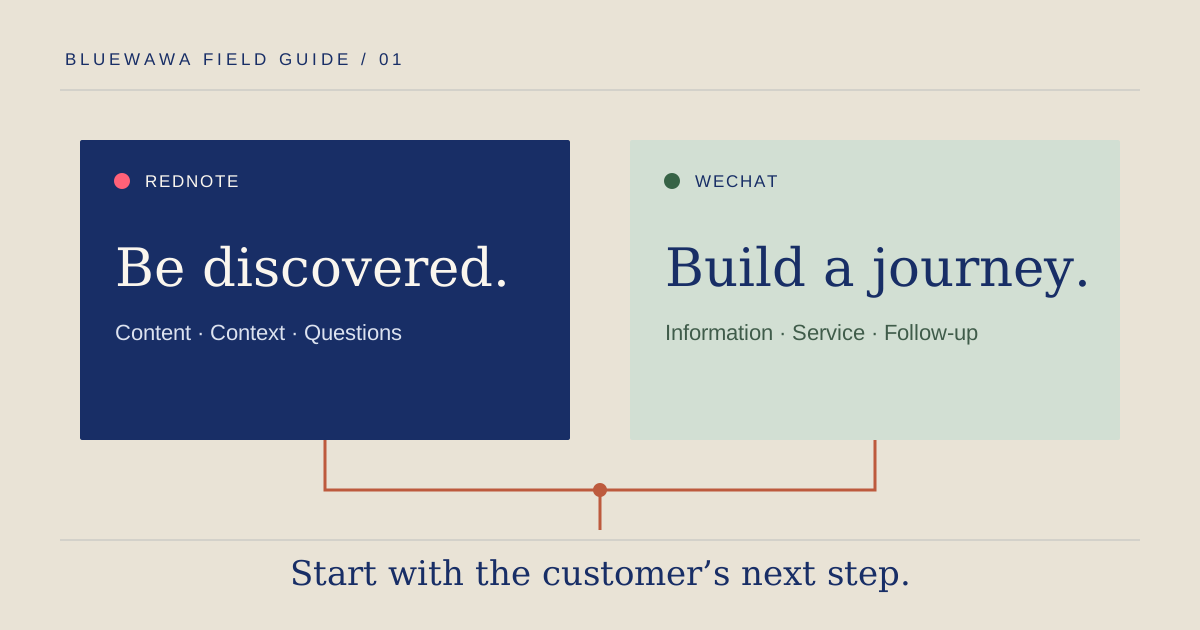
Rednote and WeChat often appear together in China marketing plans. That does not mean a new brand needs two fully staffed channels on day one. The useful question is: what does your next customer need to do, and can your team support that step?
This guide offers Bluewawa’s planning framework for overseas brands. It is a way to make a first decision, rather than a promise that one platform will outperform the other. We use “WeChat” for the brand-facing conversation here; Tencent distinguishes Weixin for mainland China from its interoperable international sister service, WeChat. Tencent’s product overview explains that distinction.
Start with the business problem
Write a one-sentence brief before comparing platform features. Include the audience, the action you want and the obstacle in the way.
“We want to grow in China” is difficult to turn into a practical scope. “We want Chinese-speaking travellers considering our destination to understand our stay and ask about availability” gives the team something to design and measure.
Separate three situations:
- Discovery: the right people do not yet know the brand or understand why it is relevant.
- Decision support: people are interested, but cannot find the information or reassurance needed to enquire or buy.
- Relationship management: people already know you, but follow-up, service or repeat engagement is fragmented.
One brand can have all three problems. Choose which one is limiting progress now. Also distinguish selling into mainland China from reaching Chinese-speaking customers who live or travel elsewhere. Geography changes the offer, service needs and practical next step.
Compare the operating jobs
The table below is our suggested way to allocate work. It describes useful starting roles, not exclusive platform capabilities: WeChat also has discovery features, and Rednote is not limited to awareness.
| Planning question | A Rednote starting point | A WeChat starting point |
|---|---|---|
| What are we trying to learn? | Which topics, use cases and questions attract relevant interest | Which information and service steps help an existing audience move forward |
| What would we build first? | A focused profile, Chinese content angles and a small publishing plan | A clear account purpose, useful content, navigation and a workable contact route |
| What does the team need? | Local research, copy, creative production and comment handling | Editorial ownership, account administration and someone responsible for follow-up |
| What should we observe? | Relevant questions, saves, profile activity and enquiries where measurable | Useful reads, menu actions, enquiries and response quality where measurable |
| What can undermine the work? | Attractive posts that never answer a buyer’s practical questions | An account that looks active but sends people into a dead-end journey |
Tencent describes a Weixin ecosystem that includes Official Accounts, Search, Channels and Mini Programs. Those are different tools within a connected platform, not a requirement to launch every tool at once. Tencent’s ecosystem overview provides the product context for this comparison.
When Rednote is a reasonable first test
Consider a Rednote-first scope when the immediate task is to develop a locally relevant story and understand how potential customers respond to it. Start with a narrow audience and use case, rather than attempting to cover every product in the catalogue.
For example, a fictional coastal guesthouse might test the idea of a quiet two-day break. The useful work includes Chinese headlines, a clear cover, practical destination information and a way to handle questions. A beautiful translated slogan alone does not explain transport, room choices or whether the stay suits a particular traveller.
Before adding creators or paid activity, agree what content the brand can support, who answers questions and what happens after interest is expressed. Check which account features and contact methods are permitted for the actual setup; do not assume an unrestricted link to another platform is available.
See our Rednote content demonstration for a fictional brief and the resulting Chinese creative. It illustrates a proposed approach, not observed campaign performance.
When WeChat deserves the first investment
Consider WeChat first when you already have people to support: event attendees, distributor contacts, guests, customers or prospects who need a reliable source of information and a responsive team.
The first release might be modest: an account with a clear purpose, a small set of useful articles, a sensible menu and a contact route that works. Define the destination for each menu item before commissioning a larger build.
If a task really needs an integrated service experience, a Mini Program may be relevant. Tencent describes Mini Programs as services accessed within Weixin, including through search or QR codes. That explains their role; it does not mean every new brand needs custom development. Tencent’s Mini Programs overview is a useful reference.
Use our WeChat launch checklist to identify the people, assets and operating decisions required before committing to a launch.
When a connected plan makes sense
It can be useful to work on both platforms when each has a defined job and the team can sustain the work. For a hospitality brief, one proposed division might be:
- Create content that helps a traveller recognise a relevant type of stay.
- Provide detailed information for people who want to investigate further.
- Give the team enough context to answer an enquiry.
- Track whether that enquiry becomes a qualified opportunity or booking.
This is a customer journey, not a claim that a specific cross-platform transfer is always allowed. Validate the actual handoff, permissions and customer experience. Avoid building a strategy around a route that has not been tested.
Running both also means more than duplicating posts. The topics may be shared, while the format, level of detail, publishing process and follow-up differ.
Define a small decision-ready pilot
Before spending, prepare a one-page pilot brief with the following fields:
| Field | What to decide |
|---|---|
| Audience and market | Who is the work for, and where will they use or buy the offer? |
| One primary objective | What would make the next investment decision easier? |
| Deliverables | Which content, account work or enquiry experience is included? |
| Owners | Who approves, publishes, responds and reviews? |
| Budget boundaries | What is included, and what needs a separate production, creator or media budget? |
| Review point | When will we examine evidence and decide what to change? |
Measure the question you set out to answer. Content engagement can suggest relevance, but an enquiry is not a sale, and a platform visit is not proof of revenue. Maintain a separate record of qualified enquiries and outcomes where the customer journey allows it. With a small sample, treat results as directional and record what remains uncertain.
Make the next move explicit
If you need to develop local creative, start with the Rednote content localization guide. If you need to organise account ownership, content and follow-up, use the WeChat launch checklist.
The best first scope is one the brand can resource, review and learn from. Expand when there is a clear reason to add the next platform or tool.
Ready to scope the first engagement? The 90-day Rednote pilot guide defines phased deliverables and review decisions. Use the agency evaluation worksheet when comparing implementation partners.
Your next step
Choose a starting point you can actually operate.
Explore the scope of our Rednote and WeChat services, then bring your audience, goal and current assets to a planning conversation.