Rednote / A Bluewawa field guide
How to Localize Brand Content for Rednote
Follow an English hospitality brief through audience framing, headline choices, cover hierarchy and a Chinese note. Includes a clearly labelled concept example.
In this guide
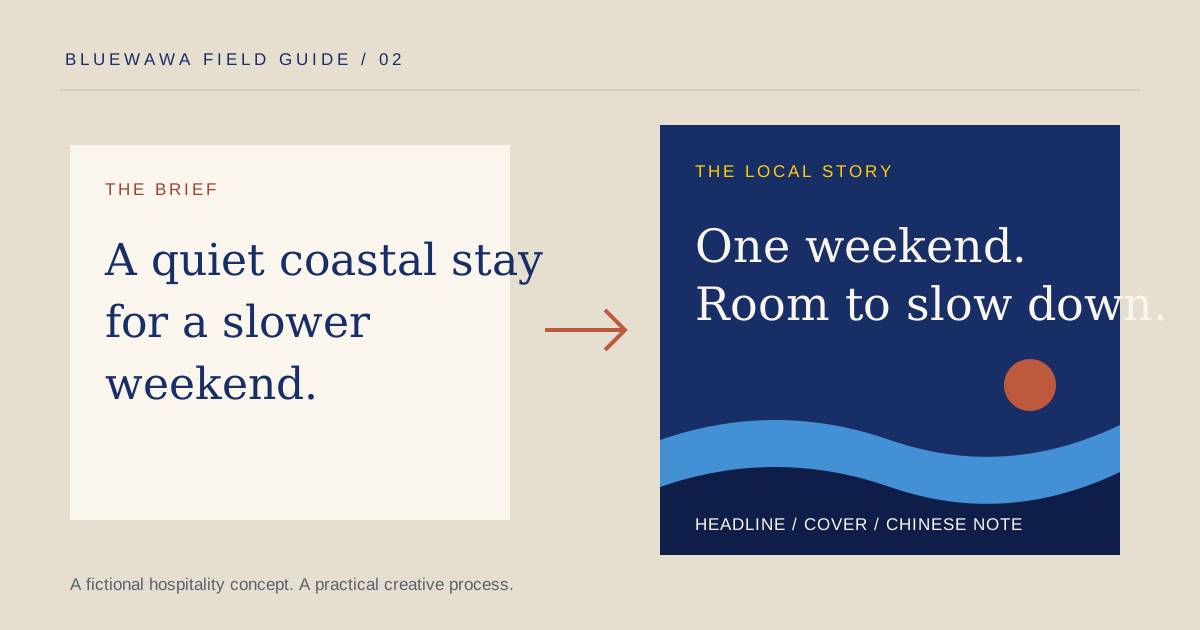
A translated post may preserve every sentence and still leave the reader with the wrong question. The product benefit is there, but the situation, visual emphasis or practical next step is missing.
Our proposed workflow starts with the audience’s task, then works through the headline, cover, body and response plan. The example below is a self-initiated concept for a fictional coastal guesthouse. It is not client work, a live post or evidence of campaign results.
Turn the brand brief into a reader brief
The starting English brief is simple:
“A quiet coastal stay for a slower weekend.”
It gives a mood, but not enough information for publication. Before writing, ask where the property is, who can realistically travel there, what the rooms offer, which assets are approved and who will answer availability questions.
For this demonstration, the proposed audience is a Chinese-speaking traveller considering a short coastal break. The content job is to make that break easy to imagine and identify the practical questions to answer next.
| Keep from the brand | Adapt for the reader | Verify before publishing |
|---|---|---|
| A calm, unhurried tone | A concrete two-day weekend idea | The actual location and travel time |
| The coastal setting | A cover with one clear reading hierarchy | Whether shown views match the property |
| The value of rest | Copy built around pace and preferences | Amenities, access and booking conditions |
This distinction prevents the creative team from filling gaps with attractive but unsupported claims. “Quiet” may be a positioning choice, but details such as private beach access, sea-view rooms or a guaranteed travel time need evidence.
Choose an angle before choosing words
A literal working translation could be:
在安静的海边住一晚,度过一个慢下来的周末。
It communicates the brief, but we can explore more specific editorial options. These are creative alternatives, not titles we have tested against an algorithm.
| Proposed Chinese headline | Editorial purpose | What still needs checking |
|---|---|---|
| 这个周末,把时间交给海 | Introduce a restful mood in a short line | Whether the visual and body make the stay concrete |
| 两天一夜,给自己一个海边假期 | Make the duration and use case explicit | Whether that itinerary is practical for the audience |
| 想慢下来?从一个海边周末开始 | Address the reader’s motivation directly | Whether the brand is comfortable with this conversational tone |
For the homepage sample, we chose the first line and paired it with a more practical subheading. The headline sets a mood; the supporting line makes the idea easier to understand. That division of work matters more than inserting as many search terms as possible.
Give the cover one clear hierarchy
The sample cover has three levels:
- Main idea: 这个周末,把时间交给海 — “This weekend, leave your time to the sea.”
- Supporting idea: 两天一夜慢下来 — a slower two-day, one-night break.
- Concrete cues: 看海 · 散步 · 好好睡一觉 — sea views, walking and rest as the editorial theme.
The illustration is original concept artwork. A real property post would need suitable, authorised imagery that accurately represents the offer. Do not replace a missing room photograph with an invented image presented as the actual room.
Review the cover at its likely mobile display size. Check whether the main line is readable without zooming, whether the image supports it, and whether any important information has been reduced to decorative small print. Keep a source file so text and layout can be adapted after review.
You can view the visual concept on our homepage. It uses the same brief as this article.
Write the note around a useful conversation
Here is the illustrative body copy:
这个周末,把时间交给海。
不赶景点,也不把行程排满。留一个下午沿着海边走走,第二天睡醒,再决定去哪儿。
两天一夜的海边假期,你更在意房间里的风景,还是出门就能散步的海岸?
The opening carries the cover’s promise into a simple imagined itinerary. The closing question introduces a real preference that could inform a conversation about the stay.
This is a creative fragment, not a complete publish-ready property listing. A real note should add relevant, verified information: destination, suitable travel plans, room options and an approved next step. Those details cannot be supplied for a fictional business.
If the reader has to ask basic questions because the post omitted everything practical, high comment activity would not necessarily indicate a successful content strategy. Review what the questions actually reveal.
Add search context without making promises
For a real assignment, research the audience’s vocabulary around the destination, category and use case. Record actual terms and the reason each belongs in the content. A phrase can be relevant to the brand yet irrelevant to the traveller’s decision.
Place useful terms where they read naturally. Avoid treating a fixed keyword count, hashtag formula or cover style as a ranking guarantee. The copy still needs to make sense to a person who knows nothing about the brand.
Search research also exposes missing information. If people are comparing access, family suitability or seasonal conditions, the content team needs accurate answers from the business before publishing. A writer should not invent these details to complete a template.
Review the whole post, including what follows it
Use a shared review sheet, with one person responsible for the final decision. Separate the checks so a design approval is not mistaken for a factual approval.
- Facts: Are the location, product details, prices and conditions accurate and current?
- Language: Does the copy sound natural, and does the English-speaking reviewer understand its intended meaning?
- Assets: Are photographs, illustrations, fonts and third-party materials authorised for the intended use?
- Platform setup: Is the content and proposed contact route appropriate for the actual account and current platform requirements?
- Commercial context: Are any creator relationships and promotional disclosures handled appropriately for the activity?
- Response ownership: Who answers questions, in which language, and what information can they confirm?
Use the platform’s professional-account learning centre as a starting point for current platform guidance. The creative suggestions in this article are Bluewawa’s proposed workflow, not platform-issued rules.
Hand over a usable content package
A useful delivery is more than a finished image. For this type of assignment, a proposed package would include:
| Deliverable | Why it belongs in the handover |
|---|---|
| Audience and angle brief | Keeps the team aligned on the reader and purpose |
| Chinese title and note | Provides the actual publishing copy |
| English explanation | Helps the global team review meaning and intent |
| Editable cover and export | Allows corrections and future adaptation |
| Fact and asset checklist | Records what was checked and by whom |
| Response prompts | Prepares the team for likely questions |
| Review plan | Defines what to observe after publishing |
After publication, inspect both the available metrics and the substance of the response. Did readers understand the offer? Which questions recur? Did relevant enquiries arrive? Treat changes to content as hypotheses to test, not proof that one phrase caused a commercial outcome.
If you have not decided where content fits in the broader plan, start with our Rednote vs WeChat guide. If interested readers need a more structured follow-up experience, the WeChat launch checklist covers the operating side.
Your next step
Bring a brief. Start with a focused content scope.
See how our Rednote services connect research, native Chinese copy, creative production and reporting.