Rednote / A Bluewawa field guide
What Should a 90-Day Rednote Pilot Include?
Give a first Rednote programme a clear question, bounded scope and review points. See what to prepare, deliver and evaluate across three practical phases.
In this guide
A first Rednote engagement should answer more than “Can we publish regularly?” It should help the brand learn whether a particular audience understands the offer, which questions matter and whether the team can support the next step.
This guide sets out Bluewawa's proposed 90-day planning framework. The time window is a project choice, not a platform rule or a promise that demand will appear within three months. A delayed account setup, seasonal offer or long buying cycle may require a different schedule.
Write the decision before writing the calendar
State the question the pilot should help resolve. For a fictional coastal guesthouse, it might be: “Can useful Chinese content about a short coastal stay generate relevant availability enquiries that our team can answer?”
That question requires more than publishing. The property must provide accurate information, the contact route must work for the actual account and someone must respond. If the brand only wants to test whether readers understand the offer, set that narrower objective explicitly.
Create a one-page pilot brief with the audience, customer action, offer, operating constraints, budget ceiling and evidence needed at the end. Use the platform comparison if the decision to start with Rednote is still unresolved.
Agree what is included and what must be ready
Identify the legal account operator, administrator, factual reviewer and response owner. Confirm the setup and permissions needed for the intended activity before scheduling it. Do not assume the first week can include publishing if the account pathway is still being resolved.
The editorial clock can start once access, approved assets, the customer route and basic reporting are ready. If setup is part of the contract, show it as a separate milestone and explain how delays affect the test period.
A bounded content pilot could include one audience, two editorial angles and six owned-account photo notes, with a review after each pair. This is an illustrative scope, not a recommended minimum for every brand or enough data to establish statistical significance. Creator collaborations and paid distribution can be separately priced options.
Keep the costs visible using the Rednote budget worksheet. If the scope changes, revise both the budget and the question the pilot can answer.
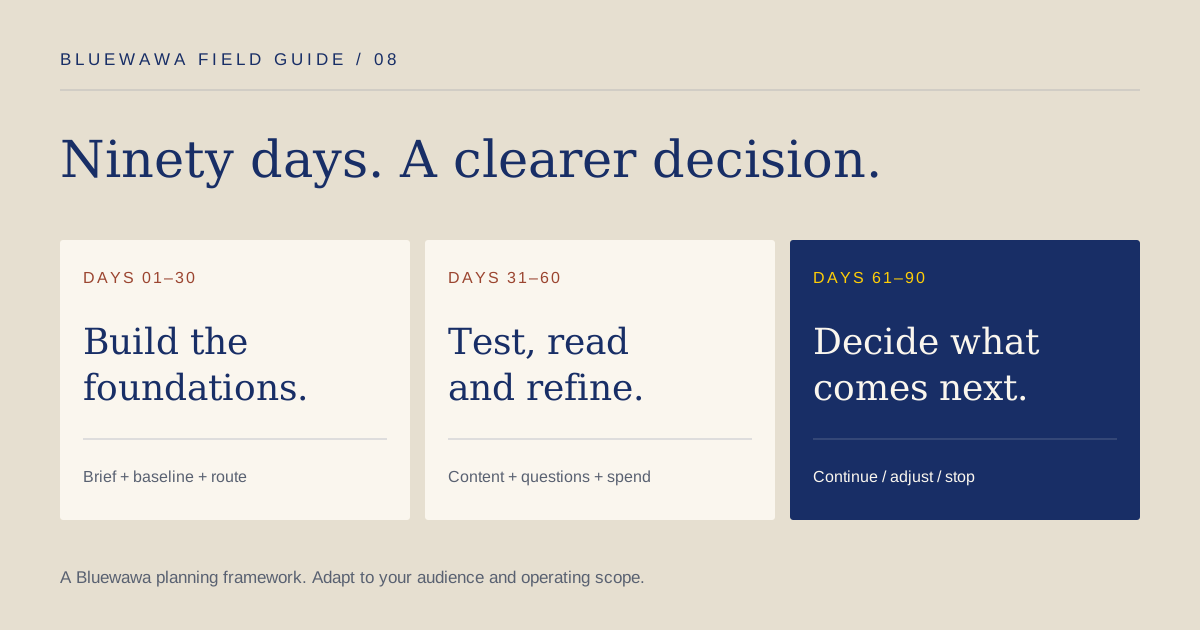
Days 1–30: establish the foundations and publish a baseline
Research the audience's questions and prepare a small content map. The keyword research guide provides a worksheet for distinguishing observed phrases from ideas that still need testing.
Choose two angles tied to the same business objective. For the guesthouse concept, one could explain the rhythm of a two-day trip while the other answers room-selection questions. Prepare factual references and an approved next step for both.
| First-phase deliverable | What the brand should be able to review |
|---|---|
| Pilot brief and responsibility map | Audience, objective, scope and named owners |
| Research and angle sheet | Source observations, proposed questions and missing facts |
| First content pair | Chinese copy, approved assets and an English explanation |
| Tested response route | A completed test enquiry and confirmation the owner received it |
| Baseline record | Publication dates, available metrics and the agreed review method |
The end-of-phase review asks whether the test is ready to operate. If enquiries cannot reach the team or the offer remains unclear, fix those issues before adding more distribution.
Days 31–60: test the next pair and investigate the response
Review the available results and the substance of reader questions. Did people misunderstand the location? Did they ask about a room feature missing from the note? Use that evidence to improve the next pair of posts.
Record what changed and why. If you alter the title, imagery, offer and distribution together, you cannot confidently attribute a difference to any single change. In a small pilot, describe observations as directional evidence rather than presenting an uncontrolled comparison as a formal experiment.
If creator or paid activity is included, keep its scope and reporting distinct. Rednote's advertising help centre and creator collaboration platform are the operational starting points for checking the current tools and workflows. Record the actual spend and distribution context alongside the content data.
By day 60, deliver an updated question map, the second content pair, a spending record and a short explanation of what the next phase will test. A list of impressions without an editorial decision is an incomplete review.
Days 61–90: complete the scope and make the decision
Use the final content pair to address the most useful remaining question. Avoid introducing several new formats just before the final review; that creates work without enough time to observe it.
Complete the agreed handover: published content links, approved copy, deliverable files, available reporting exports, spend reconciliation and outstanding enquiries. Give the brand a record another authorized operator can understand.
The final report should state what was delivered, what was observed, what remains uncertain and what scope is proposed next. If a longer observation period is needed because customers decide slowly, explain what will be monitored and when the decision will be revisited.
Define success measures that match the objective
Agree definitions before publishing. The following are suggested operational definitions for a lead-oriented pilot, to be adapted to the business.
| Observation | Working definition | Limitation to preserve |
|---|---|---|
| Delivery completion | Agreed pieces and checks completed | Delivery is not evidence of demand |
| Useful reader question | A question relevant to evaluating the actual offer | Comment activity can also reveal missing information |
| Relevant enquiry | A request fitting the agreed audience, service and next step | A relevant enquiry is not necessarily a sale |
| Response completion | The enquiry owner has answered or recorded a follow-up | A sent reply does not establish customer satisfaction |
| Confirmed commercial outcome | A completed outcome verified in the brand's records | Attribute it to Rednote only when the evidence supports that link |
If reporting a cost per relevant enquiry, state the spending basis and count. Keep media-only cost distinct from total pilot cost. With zero relevant enquiries, report the spend and zero count; do not manufacture a meaningful cost-per-enquiry ratio.
Set decision thresholds using the brand's economics and capacity before launch. There is no universal follower, enquiry or sales target supplied by this framework.
Choose continue, adjust or stop with reasons
Continue with a defined next scope when the team can operate the process, useful audience signals recur and the available outcome evidence supports further investment within the agreed constraints. Continue does not automatically mean increasing every budget line.
Adjust and retest when there is a specific, correctable issue: the content reaches an unsuitable audience, essential information is missing or follow-up is too slow. Name the change, owner, cost and review date.
Pause or stop when the brand cannot provide the required information or service, the operating route is not viable, or a fairly executed test fails the thresholds agreed in advance. First check delivery and measurement quality so that a broken process is not mistaken for a clean demand test.
For an agency-led pilot, use the supplier evaluation guide to check that the proposal includes these responsibilities and review points. The deliverable at day 90 is a supported decision about the next investment, alongside the content and operating work already completed.
Your next step
Make the first engagement a defined pilot.
Bring an audience, an offer and a practical constraint. We can discuss a first scope with clear deliverables, reporting and a decision at the end.